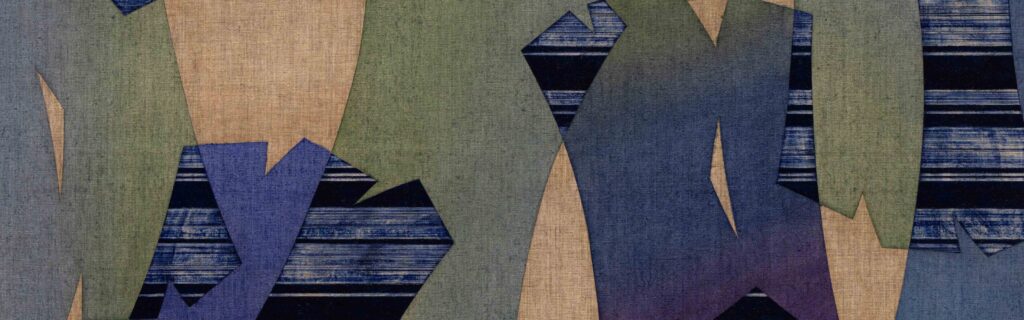
Imbued, Between the Flower and the Wind (2026)
There are moments when a plant encounters the wind. The subtle movement of the leaves is a sign of life and of the plan’s presence in a particular place over time. When a breeze finally reaches a plant that has been resting in stillness, change unfolds. I have translated this breath of nature into an internal landscape. To me, “flowers bloom and trees grow” is equivalent to the stirring of an emotion from within the soul’s depths. The wind blowing over these flowers and trees signifies the moment when an external stimulus permeates the quiet surface of my inner self.
Within the blue petals that harbor that fleeting instant, the traces of the passing wind are inscribed. Even after the wind has vanished, its lingering resonance wafts between the leaves and stems, leaving the plant unable to return to its former stillness. The wind sways these blossomed emotions, altering their colors and forms. I perceive this swaying not as a mere tremor, but as the nascent stage of transformation. Thus, I dwell within the form altered by its encounter with the wind. In this way, I have become imbued with the wind.
The breath of the wind that stirred the petals and set the leaves in motion did not disappear; it remained beside me, transformed into color. This lingering resonance resembles the trajectory of our emotions. Even in moments beyond our awareness, the mind undulates like the wind. Countless breezes of emotion gradually alter the colors of our lives. These changes permeate without boundaries—like a transparent wind—transforming my own hues and sometimes blending with others to linger as afterimages. These afterimages never reside on a single stratum. I have contemplated how the emergence of invisible emotions (flowers and trees) and the shifts in their flow (the wind) cause inner colors to overlap and what kind of layers they leave behind.
The place where one color meets another is ambiguous, like the trace of wind. By repeatedly layering and wiping away these vague boundaries, I translate the invisible flow of emotion into visual density. Like a lingering afterimage left where the wind has permeated, I leave its trace behind. Behind translucent veils of pale color, accumulated brushstrokes confront one another, creating a quiet harmony. That the colors are not entirely obscured, but instead faintly emerge, suggests they are the accumulated hues of past emotions that have long since soaked into life. I focused on how colors settle on the surface and gradually blend into and permeate one another, allowing their boundaries to become less distinct.
The layers of color, spreading and overlapping on the canvas, are an attempt to visualize the invisible flow of emotion. Through transparently accumulated colors and brushstrokes bearing traces of wind, I metaphorically express the process by which different sensibilities are superimposed. I record the texture of emotions that, having once quietly wished to bloom into a tree, have become suffused with the wind that blew through them. This reflects an attitude that does not fear being shaken by external forces, but instead affirms the new landscape shaped by the lingering resonance that remains after willingly swaying and being colored by the wind. It is not merely a record of movement, but a contemplative process in which the wind enters my inner world and takes shape through my own visual language. It resembles time layered with accumulated sensations. I build up trace of the wind’s movement on the canvas to express a state that has not yet returned to complete stillness. Through this process, I explore movement as a sign of life.
Becoming imbued, between the flower and the wind.
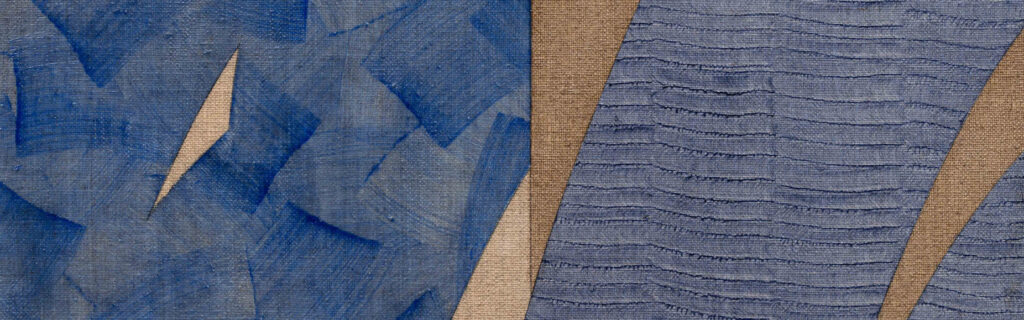
Where the Wind Touches (2025)
As I continued my work, I confronted the emotions within me. Various feelings took root and settled inside me like seeds. Hoping that these emotions would one day bloom, I stayed focused for a long time. I named the flower that finally blossomed in my heart ‘The Blue Flower’.
The blue flower grew into a tree, and more trees emerged, gathering into a dense forest. Then, the wind began to blow through that forest. It filled the spaces between flowers and branches, setting them in motion. The wind became the force that moved the flowers and trees. I wanted to capture this organic resonance in my work as well. The presence of flowers and trees was only revealed when petals fluttered and leaves scattered. I could sense that the wind had finally found its way to the flowers and trees I had nurtured within me.
The flowers and trees came into being with the wind.
In Korean, there is a word—Baramkkot(바람꽃)— which literally means ‘wind flower’. It symbolizes the fleeting energy that lingers in the moment just before the wind begins to rise. Baramkkot is a flower of connection, born from the energy of the wind. Wind can not be seen on its own. Its presence is revealed through the things it touches and moves, as it transfers its energy. The power inherent in the wind allows us to experience such connections.
I remember the Baramkkot that stayed within me. It seeps through the cracks of memory, flowing along the grain of my emotions. When a Baramkkot blooms, we become aware of our connection to the world. This feeling comes to each of us in a different way. For some, it is a sudden sensation. For others, it is a subtle tremor emerging from stillness. This intangible sense guides us toward one another. A Baramkkot is the shape of a moment that lingers at the boundary between presence and perception, disappearance and revelation. It is a layering of time and memory brought together by the wind.
I sought to express this layering visually through the translucent buildup of oil paint. With each brushstroke, I tried to convey the emotions I had felt as I scraped the paint away. I did not want this moment to simply pass, but wanted to preserve it on the surface of the canvas. As the brush took on the movement of the wind and pushed the paint across the surface, the Baramkkot emerged. I hope to remember and hold on to the time when the wind’s motion was caught at the tip of the brush.
No emotion is ever completely still or alone. In the quiet resonance, I hope our feelings find a way to connect with one another.
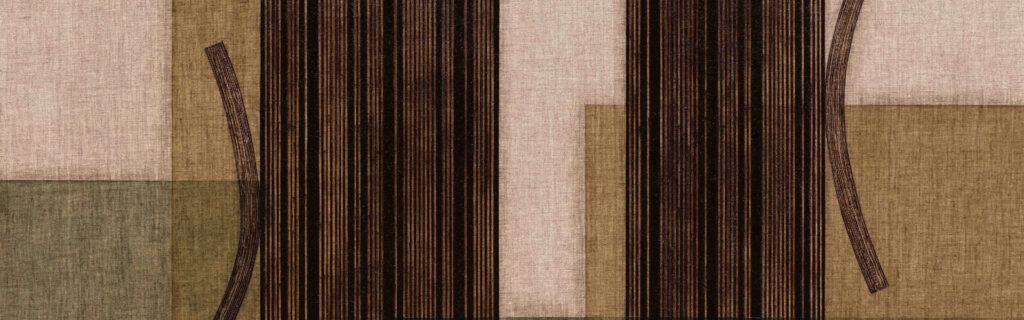
Afterimage, breeding a tree (2023)
The blue flower was a wait. Patience to reach beyond. Fragments of afterimages blooming and falling from one’s heart and glimmering before their eyes. The blue flower that bloomed in longing for the inner texture became pollen and pure blue vapor. Although there is still a method of repetitive gesture left, it differs from the work I created to catch the inner flowers I could not see. In the previous work, I tried to find the justification for working with that specific art by using the semantic meaning of “blooming” and the abstract form of flowers. Still, now the shape meant to capture the blue flowers remains in my mind, gradually disappearing, decomposed, leaving only traces. And now, the trail remains only as an afterimage. The afterimage is the trace of capturing and embracing the beyond-ness that has sub-merged into my insides. The afterimage is a record of when I desired to grasp the basic form engraved in my heart humbly. During that time, the flower grew and became a tree.
Repetitive lines as if they were coincidental, curtains cast upon like fogs, and bounded forms are distinctive. Still, they are mysterious, asking if reaching the vague inner side that holds sensitive inspiration is possible. However, when the attempt of interpretation collapses, and an inevitable wave occurs between the emotional motivations, all the rational elements for understanding disappear, and inspirational pieces fill the blank spots. It happens to me every moment. It kick-starts the opportunity for psychological sharing and provides me with an appropriate way. The interaction of consciously identifying and finding the meaning, finding gets cut off.
On the other hand, the concept, interpretation, and purpose dissolve and slips away once you submerge into the oil painting drawn on the canvas. Therefore, what is called to be the first emotional something or message that permeates the work is “me” and “my mind as self-consciousness.” As the object of work, I become a medium that cannot unite the work and me. This imperfection creates layers of multiple consciousnesses—the overlap of consciousness. I give my responses through the trajectories I began. Sensitivity requires distance. And distancing is another word for longing. I look at them giving each other specific spaces. The shape of the afterimage is not properly arranged on the screen, but I felt the form of the afterimage transferred to the canvas. The figure shown is the projection of my afterimage on my distance. My relationship with my work is a non-direct relationship, an incomprehensible one. For me, the afterimage is a cross-section revealed. From my pictorial perspective, I repeat going into the work and sliding, distancing myself from the work, and responding to it. The time of coordination piled up to form a texture and became a tree.
Longing is not what is called empty-ness. Afterimages are not the absence of objects. It wants you to experience and recognize what you missed if you didn’t stare quietly and wait patiently. It is the trace of applying oil paints thinly several times or wiping them repeatedly, which touches the eyes and makes you pay attention to them. A trail leaves a mark or trace. The debris left is longing, or in my language, afterimage. The image continues emerging even after the external stimulus disappears due to sensory experiences. Life is made up of traces, which are made up of memories and appear as afterimages. To focus on the process of doing this experience, I worked in layers at intervals of time. I expressed it by overlapping the time and gaze. It appears as a trace of a trace. It captures the multi-layered form of emotions. The afterimage fills the gaps between the remaining texture and holds the time and material. Then, the single surfaces from trees.
I worked in a tranquil time to communicate with the movement when working and use it to focus more on the situation and capture the time and mind. I carefully prevented the spread of the form in hopes of quietly staring at the work and hoped the viewers to fall into it slowly. I paid attention to uncontrolled expansion, and the spread headed inward, not outward. The lines that leave scars are done under the plan with a sense of rhythm, and the natural distance that was caused due to this process was, of course, accepted. The two areas divided in this way expand to the inner infinity of self-definition with the repetition of disappearance and appearance, where it will disappear and where it does not disappear to spread traces and parts that have not been drawn out, just as the growth rings that trees bare inside. Also, if you look closely at the area of the paint that forms the line, the part of the line drawn, and the traces are enlarged. I didn’t want dichotomous confrontation, such as good and evil, chance and plan. They are afterimages in the formation process as a relationship that drives each other rather than an aggressive and disconnected relationship. Instead of looking at a line, or a pillar in which the strings are bound, it meets the entire shape process formed between the erased and covered traces. The afterimages that carry, color, and relate to each other are those kinds of personalities that are wealthy and doubled. The hours-long knocks come naturally. The difference in the quantitative of terrapin spreads the paint, Wrapping it gently and naturally. It’s about delivering something that can’t be said through a performative afterimage. It shows the impression of defects in the process of being transmitted by trace. It is to repeat the paths of the paint engraved by me, the pulling and pushing, and to overlap and reflect on the impressions. As I face the work, I become silent, thinking of my work, and recalling the subject of each piece. It’s not that I embody the afterimages that come to me, but a trace of the afterimages is being filtered through me. My work is not about conveying concepts and meanings but about sharing impressions. I hope this remains as a foggy afterimage and becomes a tree and calmly remains after on.
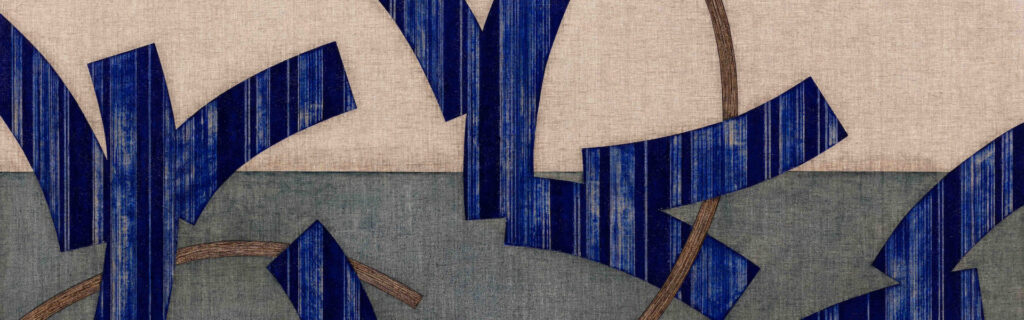
The Blue Flower (2020)
My blue flower, a blue flower blooming in a dream. A dream of a blue flower. The night is the home of our minds and dreams are a resting place away from the movement of the day. The blue flower is the image of my mind. The blue flowers that have fallen overnight condense strength for the day. Daytime becomes a pattern created by the flowery nighttime. The blooming of a blue flower is symbolized via the aspiration to find a blue flower that creates and fills the texture.
The trace of blue on the canvas is reminiscent of the fluttering petals in a dream. A dream is a time to return our minds to their original form. In this blue trace, the artist believes that the viewers can escape from the world of Baudrillard’s significance and grow their spirit and emotion. Art and artwork are not about the fact, nor is it about the principle of an object. Like plants, they contain the truth in their own right. Nature is not a mechanistic-being subordinate to a heteronomous casual inevitability. The blooming of flower is what Kant called “natural end or purpose [Naturzweck]” that provides life to itself and has its own cause and effect. Nature is always the same. Seeds have everything of their own. The power of plants lies, right here. The germination of seeds transforms itself into a plant through the nourishment of the earth and condenses itself back into a seed to lead an infinite life.
It does not wait to mystify and subjectify the artwork as if it were in a dream. A series of blue flowers is drawn as a result of the artist’s conscious composition, not by chance and unconsciousness. It longs for organismic artwork that coincide sensibility and reason, and consider both natural and artificial balance. In other words, blue flowers are an expression of the artist’s yearning it crossed between Scylla and Charybdis, which is an answer to the gap between finite and infinite, objectivity and non-objectivity.
The blue flowers are abstract of an unattainable ideal. We can never reach the infinity of the mind. Even though we cannot grip the flower with our hands, trying to find and expressing them will enrich our souls.
Aristoteles thought that every being has an intrinsic “Psyche”. As a unique vigor, Psyche is connected to the breath of all life like the root of a plant, as it has individual features. Blue flowers appear on the canvas as a trace of breathing. Blue flowers are my own breath and a unique expression of his own mind. Blue Flowers cover the earth of the mind by blowing away petals.
Psyche means ‘Anima’ in Latin, which is the soul. If you change the soul into the mind, life will have its own intrinsic spirit. Here, the repeated act of covering the canvas with oil-colors and then wiping it off represents the blossoming of the blue flower in the earth of the mind. Through this action, the artist asks us the question of our existence. By asking with this question, he seeks to escape the violence of total completeness and revive individual experience. In his case, the mind is embodied in the form of a blue flower.
A product of free and infinite imagination. An intermediate product float between nature and artificial. A journey to find blue flowers. For the most spiritual flowers.